Aug
Hair Tips
Hair Vietnam: Why Is Vietnamese Hair So Popular Worldwide?
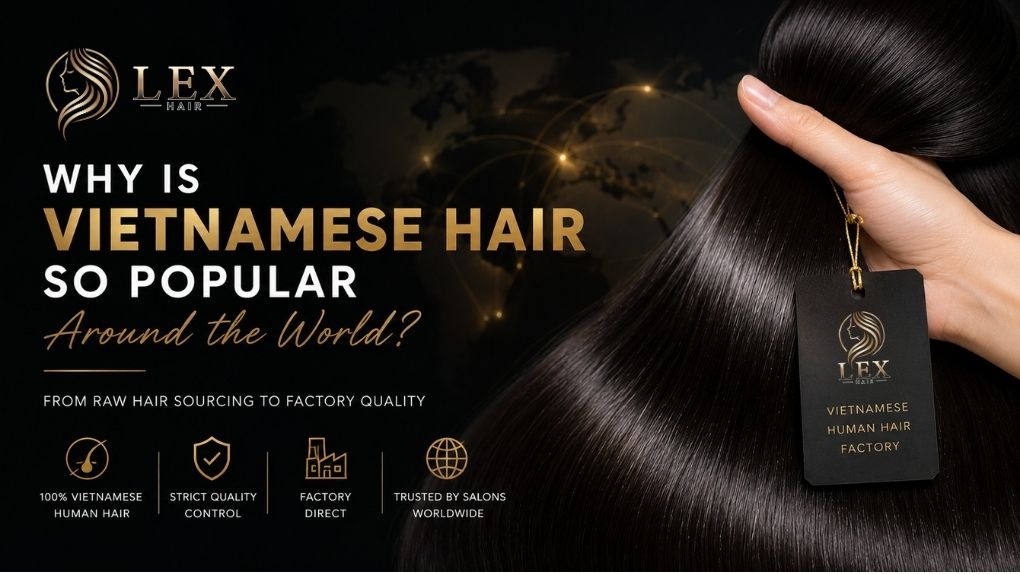
If you have ever searched for hair Vietnam, Vietnamese hair, or a human hair factory in Vietnam, you have probably noticed how frequently Vietnamese hair appears in the international hair market.
Vietnamese hair is used for bundles, wigs, closures, frontals, extensions, and customized hair products sold across the USA, Europe, Africa, and other markets.
But what actually makes it attractive to international buyers? The answer is more complicated than simply saying that Vietnamese hair is “strong” or “beautiful”. The real value comes from the entire journey of the hair:
Donor → Sourcing → Sorting → Processing → Quality Control → Finished Product
Understanding that journey is the key to understanding why Vietnamese hair has built such a strong reputation internationally.
1. First, What Does “Vietnamese Hair” Actually Mean?
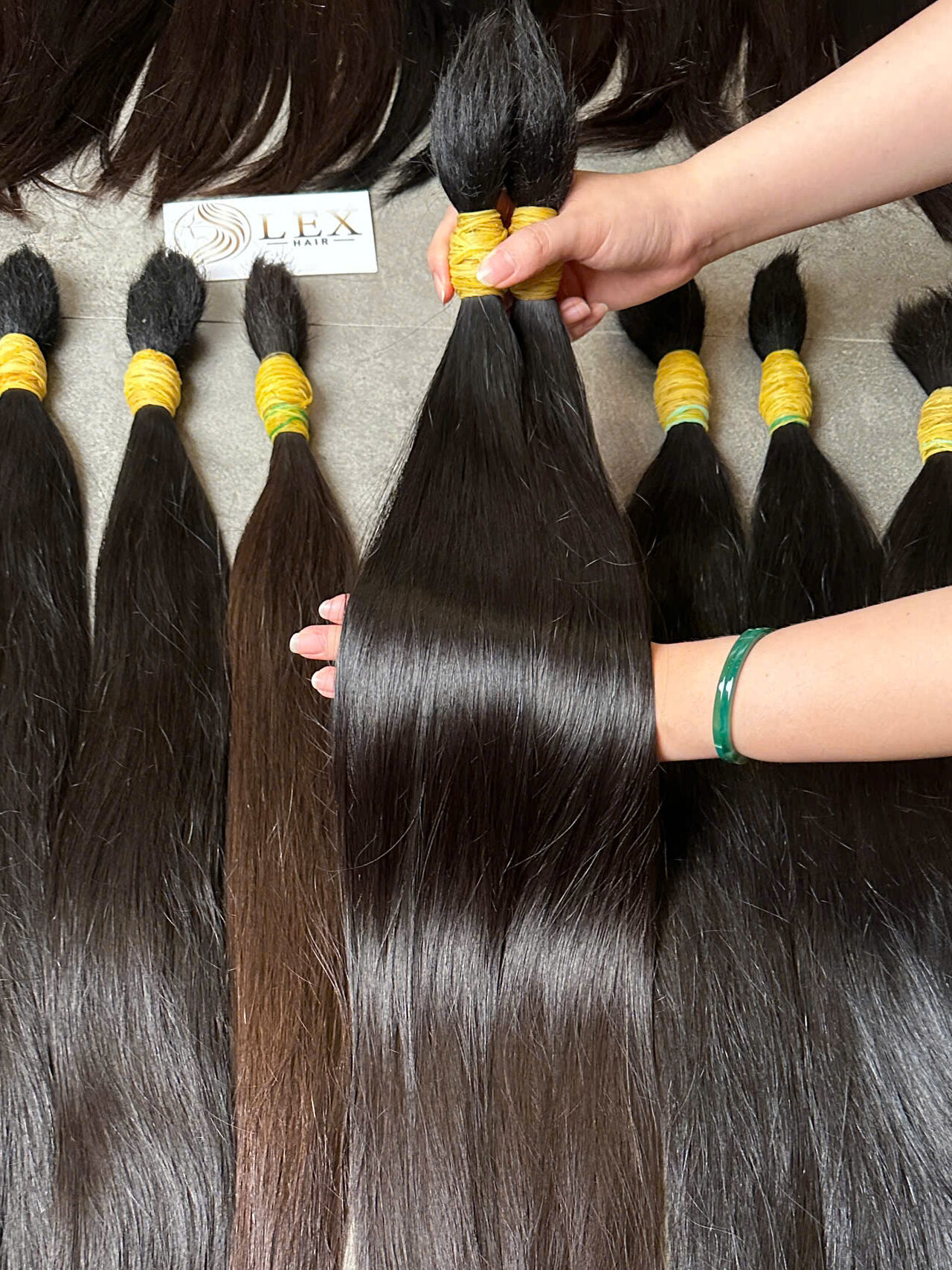
One of the most common mistakes among new buyers is treating Vietnamese hair, raw hair, virgin hair, and single-donor hair as the same thing.
They are not.
Vietnamese hair describes the origin of the hair. Raw hair describes hair that has undergone little or no chemical processing. Virgin hair generally refers to hair that has not been chemically processed, although definitions can vary between suppliers and markets. Single-donor hair refers to hair collected from one individual donor rather than mixed from multiple donors.
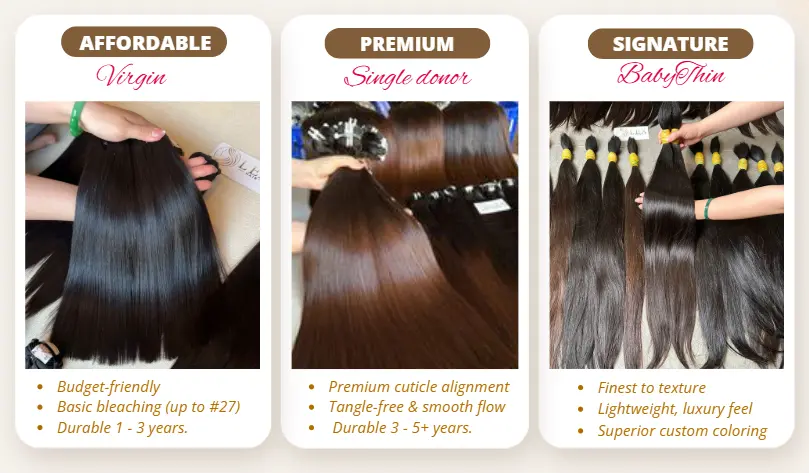
This distinction matters.
A product can be Vietnamese-origin hair without being raw hair. It can also be marketed as “virgin” without being single donor. Therefore, when researching a Vietnamese hair supplier, buyers should look beyond the country name and ask about the hair’s actual sourcing and processing history.
What makes genuine raw Vietnamese hair valuable?
When properly sourced, raw hair can retain much of its natural structure and original characteristics.
The cuticle layer remains an important part of this.
When the cuticles are intact and aligned in the same direction, the fibers generally experience less friction against one another. This can contribute to:
- Better manageability
- Less tangling
- More natural movement
- Better texture retention
- Greater durability when properly maintained
However, raw hair should not be described as hair that “never tangles” or “cannot be damaged.”
Hair quality still depends on the donor, collection method, sorting, processing, manufacturing, and aftercare.
The word “raw” tells you about processing history — not automatically about overall quality.
What Makes Vietnamese Hair Structurally Different?
Vietnamese hair is widely known for its relatively strong and substantial hair fibers.
But what does “strong hair” actually mean?
For manufacturers and professional buyers, several characteristics matter.
Fiber Diameter
Fiber diameter affects how full and substantial the finished hair can feel.
Hair with relatively larger or denser fibers can create a fuller appearance without requiring excessive amounts of hair.
Tensile Strength
Tensile strength refers to the amount of pulling force a hair fiber can withstand before breaking.
This matters during manufacturing, brushing, styling, and everyday use.
Elasticity
Healthy hair can stretch to a certain degree and return toward its original form.
Good elasticity is particularly useful when hair is curled, straightened, or otherwise restyled.
Cuticle Condition
An intact cuticle helps protect the inner structure of the hair shaft.
Healthy hair can stretch to a certain degree and return toward its original form.
These factors work together. So instead of simply saying: “Vietnamese hair is strong.”
A more useful explanation is: Vietnamese hair is valued because its natural fiber characteristics can provide a good combination of density, strength, elasticity, and styling versatility when the hair is properly sourced and processed.
That is a much more meaningful way to evaluate hair quality.
3. Natural Dark Hair Gives Vietnamese Hair Another Advantage
Most naturally sourced Vietnamese hair is found in dark shades, typically ranging from deep black to dark brown.
For a hair manufacturer, this natural base is important.
Dark natural hair can be transformed into many different commercial products through controlled processing:
Natural dark hair → Lightening → Coloring → Texture development → Finished product
This is where factory expertise becomes critical.
Taking naturally dark hair to a lighter shade such as blonde or 613 requires significantly more processing than simply keeping the hair in its natural color.
The challenge is to achieve the required color while maintaining as much fiber integrity as possible.
This leads to an important distinction:
Good raw material does not automatically create a good finished product.
The final quality depends on:
Raw material + processing technique + experienced workers + quality control
A factory that starts with good hair but processes it poorly can still produce a poor final product.
Conversely, experienced manufacturers can get much more value from high-quality raw material by controlling the processing carefully.
This is one reason the manufacturing side of the Vietnamese hair industry matters just as much as the original source of the hair.
4. From Donor to Factory: How Vietnamese Hair Is Sourced
The Vietnamese hair supply chain involves more than simply buying hair and putting it into a bundle.
Depending on the supplier and product category, the process can involve several stages:
1. Donor Sourcing
Hair is collected through sourcing networks connected to individual donors.
The original condition of the hair matters significantly.
Length, natural texture, color, density, and previous treatment history can all affect its value.
2. Hair Vietnam collection
Hair must be collected carefully to preserve its direction and condition.
For raw hair, maintaining the natural orientation of the strands is particularly important.
3. Sorting
Once collected, hair needs to be sorted according to factors such as:
- Length
- Texture
- Color
- Density
- Quality
- Condition
- Processing history
This stage requires experience.
Two bundles can have the same advertised length but look very different because of differences in density, strand thickness, or sorting quality.
4. Preparation and Processing
Depending on the final product, the hair may undergo different processes.
Raw hair intended to remain natural requires a different treatment approach from hair being transformed into a specific curl pattern or color.
5. Manufacturing
The prepared hair can then be manufactured into:
- Weft bundles
- Bulk hair
- Wigs
- Closures
- Frontals
- Tape-in extensions
- Keratin-tip extensions
- Other customized products
6. Quality Control
Quality-control teams check the finished product before packaging and export.
This can include checking:
- Length
- Weight
- Density
- Texture
- Color
- Hair direction
- Overall appearance
- Construction quality
This entire chain is what turns raw material into a commercially reliable hair product.
5. Why Processing History Matters More Than Many Buyers Realize
When comparing hair products online, buyers often focus on appearance.
The hair looks shiny.
The bundle looks thick.
The waves look beautiful.
But appearance alone does not tell you how the hair was produced.
Some commercial hair products may be chemically treated, coated, blended, or processed to achieve a particular appearance.
This is why experienced buyers ask about processing history, not just appearance.
When evaluating raw or virgin hair, useful questions include:
- Is the hair chemically treated?
- Has it been colored?
- Has it been bleached?
- Is the texture naturally occurring or created through processing?
- Is it single donor or mixed donor?
- Are the cuticles aligned?
- Has silicone or another coating been used?
These questions help distinguish genuine raw material from hair that has simply been made to look good temporarily.
A useful principle for buyers is:
The history of the hair matters as much as the appearance of the hair.
6. Vietnamese Hair vs. Indian, Cambodian and Chinese Hair
There is no scientifically valid rule saying that one country’s hair is always better than another country’s hair.
Hair quality varies enormously between suppliers.
The more useful comparison is to look at sourcing, processing, texture, consistency, and manufacturing model.
| Factor | Vietnamese Hair | Indian Hair | Cambodian Hair | Commercial/Processed Hair |
| Raw hair availability | Strong supply in specialized segments | Very large and diverse raw-hair market | Important raw-hair segment | Usually less focused on raw sourcing |
| Natural texture retention | High when properly sourced | High when properly sourced | High when properly sourced | Depends heavily on processing |
| Processing level | Can range from raw to heavily processed | Can range from raw to processed | Can range from raw to processed | Usually higher |
| Consistency | Depends on sorting and supplier | Depends on sourcing and sorting | Depends on sourcing and sorting | Often standardized for mass production |
| Price positioning | Broad, with premium raw hair available | Very broad | Often premium in selected segments | Broad |
| Main buyer consideration | Origin + strength + processing + consistency | Origin + texture + sourcing | Texture + raw quality | Product specification + price |
The important point is this:
Hair origin tells you where the hair came from. It does not tell you everything about how good the hair is.
A reliable buyer should evaluate the supplier’s sourcing and manufacturing process rather than choosing purely based on country of origin.
7. Why International Buyers Source Hair Vietnam Directly From Factories
The next question is not only: “Why Vietnamese hair?”
It is also: “Why buy directly from a Vietnamese factory?”
Consider the traditional supply chain: Donor → Collector → Trader → Exporter → Distributor → Salon
Every additional layer can potentially add cost, communication barriers, and distance between the buyer and the original production process.
A factory-direct model can be much simpler: Sourcing Network → Factory → Quality Control → International Buyer
But factory-direct should not simply mean “cheaper.” Its bigger advantage is proximity to the source of quality. Working directly with a factory can give buyers better access to:
Quality Information
The buyer can ask questions directly about sourcing, production, and QC.
Customization
Products can potentially be specified according to:
- Length
- Weight
- Density
- Texture
- Color
- Lace type
- Wig construction
- Packaging
- Branding
Consistency
For a salon or wholesale business, consistency between the first order and the next order can be more important than finding the cheapest possible price.
Faster Feedback
If a buyer notices an issue with a product, direct communication with the manufacturer can make it easier to identify the production stage responsible for the problem.
This is especially valuable for businesses that place repeat orders.
8. How to Tell Whether a Vietnamese Hair Supplier Is Reliable
Searching for Vietnamese hair supplier will bring up many websites and social media pages.
But not every supplier is necessarily a manufacturer.
Before placing a large order, professional buyers should ask several basic questions.
Ask about the source
- Where is the hair collected?
- Is it Vietnamese-origin?
- Is it single donor?
- Is it mixed?
Understand the Processing
- Is it raw?
- Has it been chemically treated?
- Is the texture natural or processed?
- Has it been colored or bleached?
Ask about consistency
- How is density measured?
- How is the hair sorted?
- Can future orders match the sample?
- How are different lengths handled?
Ask about the factory
- Can the supplier show the actual production environment?
- Can you see workers processing the hair?
- Is there a real quality-control process?
- Are you dealing directly with the manufacturer or a trading company?
A professional supplier should be able to answer these questions clearly.
And if a supplier cannot explain where the hair comes from or how it is processed, a low price should not automatically be considered a good deal.
9. Inside a Vietnamese Human Hair Factory: The LexHair Approach
At LexHair, we believe buyers should not have to rely only on product photographs or marketing descriptions.
They should be able to understand what happens behind the product.
LexHair operates as a factory-direct human hair manufacturer in Vietnam, based in Da Nang.
Our production process connects Vietnamese hair sourcing with sorting, manufacturing, quality control, and finished hair products for international customers.
This means the factory is not simply a place where the final bundle is packaged.
It is part of the entire value chain. This is also why real factory content matters.
A supplier can say: “Our hair is high quality.”
But showing the actual sourcing, sorting, production, and QC process provides much stronger evidence.
For LexHair, factory transparency is part of how we build long-term relationships with international salons, wholesalers, distributors, and hair businesses.
10. Who Is Vietnamese Hair Suitable For?
Vietnamese human hair is not limited to one type of buyer. It can be particularly relevant for:
Salons
Businesses looking for consistent hair extensions, wigs, and customized products for their clients.
Hair Wholesalers
Companies that need repeatable quality and multiple product categories.
Wig Brands
Businesses looking for raw materials and finished wigs with customized specifications.
Hair Distributors
Importers looking for a reliable Vietnamese hair supplier with export capabilities.
Growing Hair Businesses
Smaller businesses that want to start with samples or smaller orders before scaling their sourcing.
The right product, however, depends on the buyer’s market.
A salon focused on natural-color extensions may have very different requirements from a wig brand specializing in blonde units or an African wholesaler looking for high-density bundles.
That is why supplier communication and customization matter.
The Real Reason Vietnamese Hair Has Become Globally Popular
So, why is hair Vietnam so popular around the world?
Not simply because Vietnamese hair is “better.”
Its appeal comes from the combination of several factors:
Natural hair characteristics
Experienced sourcing and sorting
Raw and virgin hair availability
Manufacturing expertise
Quality control
Factory-direct international supply
The origin of the hair matters.
But the journey from donor to finished product matters even more.
Vietnamese hair is only the beginning. The real difference is what happens between the donor and the final bundle.
For buyers researching raw hair Vietnam, Vietnamese hair suppliers, or a human hair factory in Vietnam, the best place to start is not with the cheapest quotation.
Start by understanding the source, processing history, manufacturing process, and quality-control system behind the product.
Once you understand those factors, comparing suppliers becomes much easier.
Explore Vietnamese Hair from a Factory-Direct Source
If you are researching Vietnamese human hair for a salon, wholesale business, wig brand, or hair extension business, you can explore the LexHair product catalog, including Raw Hair Bundles and Curly Raw Hair.
You can also learn more about LexHair’s factory and company story in Da Nang to understand how our products are sourced and manufactured.
Not sure which type of Vietnamese hair is right for your market? Contact LexHair for a free consultation.
Related Hair Tips
- How to Tell If Raw Hair Is Really Raw Hair
- Raw Hair vs. Virgin Hair vs. Remy Hair: What’s the Difference?
- How to Care for Raw Vietnamese Human Hair and Make It Last Longer